
Where the Earth Breathes Fire: Hiking Central America's Most Active Volcano
Updated: Mar 6

By Britney Tombarge - Assistant Travel Designer, Latitude Expeditions
Standing on the ridge, we hear a deep, thundering boom roll through the air. A column of molten lava launches skyward, arcs in slow motion, and scatters down Fuego’s impossibly steep cone, like glowing embers tumbling from a fire. The crowd erupts in cheers, then falls silent again, mesmerized. A plume of ash billows upward, hanging in the sky, marking the eruption that just tore through the earth. Seconds later, another explosion follows—then another, and another—each one a reminder of the raw, unpredictable power beneath our feet. It’s a moment that instantly becomes a core memory.

When I first learned about the Acatenango overnight hike, it shot straight to the top of my bucket list. For my birthday, I arranged a trip to Guatemala, wanting a challenge, an adventure, and a story to mark a new year of life. Luckily for me, January is peak season for this trek: clear skies, dry trails, and some of the best visibility for Fuego’s near‑constant eruptions.

After two days acclimating in Antigua’s colonial charm, we were picked up early in the morning for
our two‑day expedition. We trekked with V‑Hiking, a locally owned guiding company known for their experience on Acatenango and their commitment to hiring and training guides from the surrounding communities. They are well regarded for breaking groups into smaller, paced teams with one guide per every 6-7 hikers. We were welcomed at the owner’s mother’s home at the base of the volcano, served a hearty breakfast, briefed on safety, and given the chance to rent any last‑minute gear before driving to the trailhead.
The hike to base camp is only 4.5 miles, but it climbs nearly 5,000 feet, an ascent that takes most groups 4–6 hours. We carried everything we needed for the night: layers, snacks, 4 liters of water, and a change of clothes. Porters are available for hire to conserve energy, but we chose to go it on our own.

Acatenango is a stratovolcano with four distinct ecological zones, and you’re immersed in each one as you climb:
Agricultural fields at the base, where locals farm corn and beans in volcanic soil.
Dense cloud forest, humid and jungly, with thick roots and mist swirling through the trees.
High‑altitude pine forest, where the air cools and you rise above the clouds.
Volcanic scree, barren and sandy, the final stretch before camp.
Trekking dogs trot alongside you, weaving between hikers like seasoned mountaineers. As we rounded the final bend toward base camp, Fuego erupted for the first time—our welcome to the mountain.

V‑Hiking’s base camp sits on Acatenango’s western slope, directly facing Fuego. The cabins (private or shared) have windows framing the volcano like a living movie screen. After lunch and a short rest, you decide whether to attempt the optional Fuego ridge hike. Almost everyone in our group
chooses to go.
This section is steeper, looser, and more technical than the climb to base camp. We descended Acatenango on shifting volcanic gravel, then climbed straight up Fuego’s ridge, an exposed, knife‑edge trail where the eruptions grow louder with every step. The sun begins to set, revealing a colorful 360‑degree panorama: endless volcanoes on the horizon, a sea of clouds below, base camp glowing in the distance, and Fuego towering in front of us.
Once darkness falls, the real spectacle begins. What had earlier been gray plumes in the daylight becomes a fiery fountain with bright orange lava shooting into the night, sometimes multiple times per minute. Each eruption sends glowing boulders tumbling down the cone, carving bright orange trails through the black volcanic sand. The sound is otherworldly: deep, thunderous booms followed by the crackle of cooling rock, echoing across the valley. Standing just a few hundred feet from an active volcanic crater feels surreal, almost impossible. The beauty is hypnotic and the danger is humbling. One of those rare moments when nature feels both ethereal and terrifyingly powerful. I couldn’t look away.
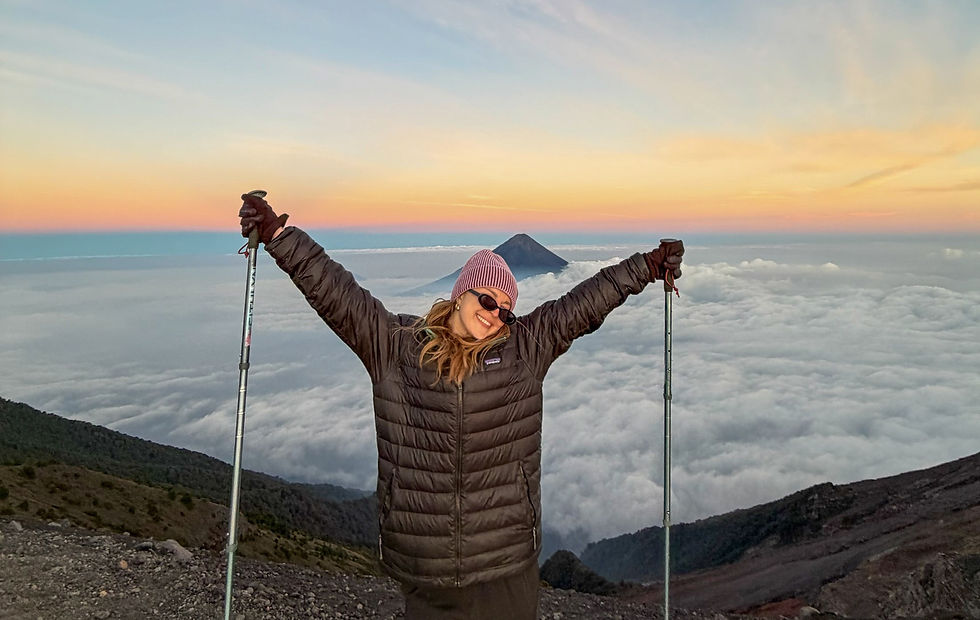
After an hour perched on the ridge, the guides signal that it’s time to head back. The temperature drops sharply, and the warmth of the lava glow gives way to the cold bite of high-altitude night air. Descending Fuego’s loose volcanic gravel in complete darkness is mentally exhausting. I relied entirely on my headlamp and trekking poles, planting each step carefully to avoid sliding. Fatigue from the day’s climb began to settle deep into my legs. The ascent back up Acatenango is even more brutal: a relentless, lung-burning climb that feels twice as long in the dark. But there’s a strange clarity that comes with pushing your body past what you thought it could do. By the time we reached base camp, exhilaratingly exhausted, I felt a profound mix of relief, pride, and gratitude.

Back at camp, dinner, hot chocolate, and wine feel like luxuries. We cozied up in our cabin and watched the night sky flicker with orange light, soft at first, then bright enough to silhouette the entire ridgeline. Every few minutes, a distant rumble rolled through the valley. It was equal parts peaceful and electrifying, like nature was putting on a private show just for us. But the real jolt came in the middle of the night. At some point we were snapped awake by a boom so loud it felt like the sky had cracked open. It was sharper, closer, and more powerful than anything I had ever heard in my life. I sat up in bed, heart racing, staring out the window as lava shot into the darkness, realizing I was witnessing the earth in its most primal, unfiltered form. It was jolting and awe‑inspiring and unforgettable all at once.
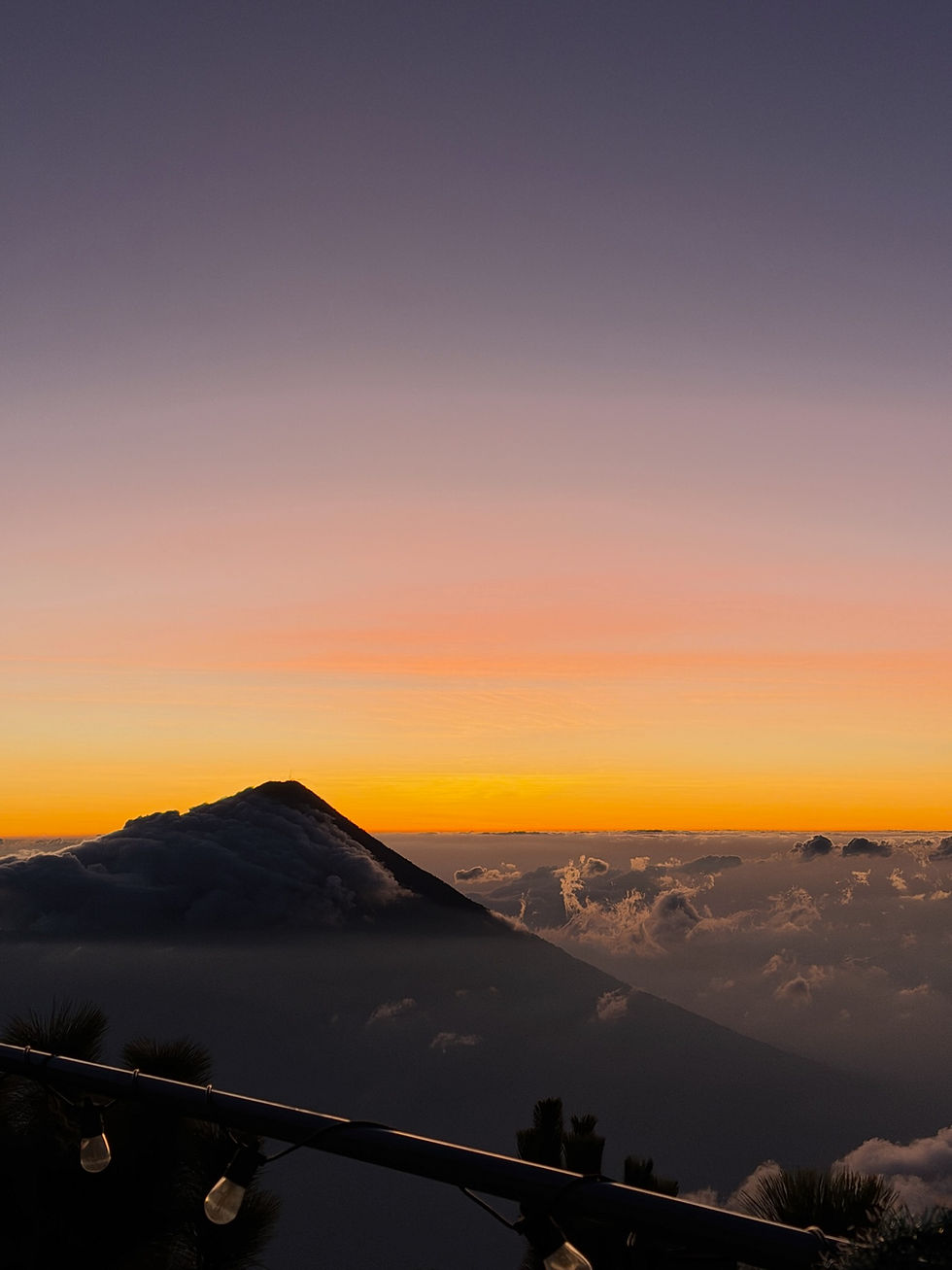
The guides wake hikers at 3:45am for the optional summit push to Acatenango’s 13,044‑foot peak, but we chose to stay wrapped in our blankets and watch the sunrise from camp instead. As the first light crept over the horizon, the entire volcanic chain of Guatemala revealed itself: Agua, Pacaya, Tolimán, Atitlán, and Fuego still puffing ash into the morning sky. The colors were unreal. Pinks, golds, and deep purples washed over the clouds below us like an ocean. We savored the perfect, peaceful morning along with our coffee and banana bread.
Once the others returned, we began our descent. This last stretch is fast and almost as fun, a controlled slide down volcanic sand that takes a fraction of the time it took to climb. By the time we reached the bottom, a warm breakfast awaited us at a small family-run restaurant overlooking the fields. Sitting there with our new friends, sipping coffee and replaying the moments from the night before, it hit me just how extraordinary this experience had been. It wasn’t just a hike. It was a journey into the heart of the Earth and a memory I’ll carry for the rest of my life.


Comments